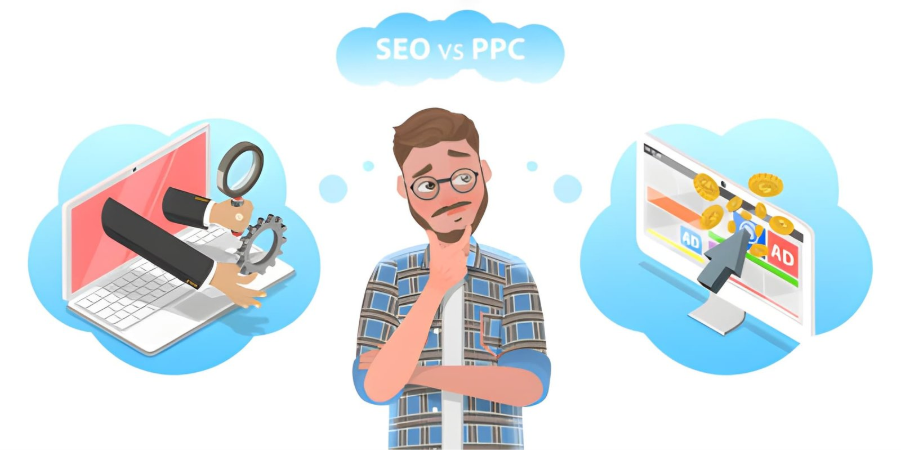
Every business owner reaches this crossroads eventually. You have a marketing budget, limited time, and two channels that everyone seems to recommend - PPC advertising and SEO. Both promise visibility, both promise leads, and both cost money if done wrong.
So, which one is better for your business?
The straight answer: it depends on where your business is, what your goals are, and how fast you need results. But that answer only becomes useful when you understand what each channel does, where each one wins, and most importantly - how to combine them into a strategy that compounds over time.
In 2026, businesses making the smartest marketing decisions are not choosing between PPC and SEO. They are learning when to use each one and why working with the right PPC advertising agency or a full-service digital team makes all the difference in execution.
Let's break it down properly.
What PPC and SEO Actually Are Beyond the Buzzwords?
Before comparing them, it is worth being precise about what each channel delivers.
PPC advertising is a paid channel where you bid to show your ads in front of targeted audiences on Google Search, Google Display, YouTube, Meta, or other platforms. You pay each time someone clicks. Done correctly, it puts your business at the top of search results or in front of your ideal customer almost immediately after launch.
SEO is the process of earning organic, unpaid visibility on search engines by building authoritative, well-structured, and intent-aligned content over time. There is no cost per click, but there is a significant investment of time, strategy, and expertise before results compound.
Both channels are legitimate. Both deliver ROI. But they operate on entirely different timelines, mechanics, and business contexts, which is exactly why comparing them side-by-side matters.
How PPC Advertising Works and When It Wins?
When a business needs leads now, PPC is the answer. A well-managed campaign through a qualified pay per click advertising firm can go from strategy to live traffic in a matter of days. That speed is unmatched by any other digital channel.
Here is what makes PPC uniquely powerful in 2026:
Precision targeting: You control exactly who sees your ad. Age, location, search intent, device, income bracket, even the time of day. No other channel lets you zero in on your ideal buyer with that level of control.
Scalable spend: Start small, prove the model, then scale what works. PPC is one of the few marketing channels where you can increase revenue predictably by increasing spend once the campaign is optimized.
Immediate data: Within 48-72 hours of launching, you have real performance data. Click-through rates, cost per conversion, which ads work, and which do not. That feedback loop is invaluable for refining both your paid strategy and your broader business messaging.
Retargeting capability: PPC lets you stay in front of warm prospects - people who visited your site but did not convert - across platforms. In a world where customers need 6-8 touchpoints before buying, retargeting closes the gap.
The limitation? The moment you pause your budget, the traffic stops. PPC is a powerful engine, but it requires consistent fuel. That is why the quality of the PPC advertising campaign management behind it matters enormously.
How SEO Works and Where It Compounds?
SEO is a long game. A strong SEO strategy builds organic search visibility that does not disappear when you stop paying. Done right, it creates a compounding asset - one that gets more valuable over time as your domain authority grows and your content earns rankings across more search terms.
Here is what makes SEO irreplaceable for long-term growth:
Free, sustainable traffic: Once your pages rank, organic clicks cost nothing. A top 3 Google ranking can drive consistently qualified traffic for months or years without incremental spending.
Trust and credibility: Organic rankings carry implicit credibility. Consumers trust organic results more than paid ads, particularly for considered purchases. Ranking well signals authority in your space.
2026 SEO reality: In 2026, Google's AI-powered search features have made SEO more technical and more strategic than ever. A skilled SEO marketing firm does not just optimize keywords - they build topical authority, structured data, and content ecosystems that earn visibility in both traditional and AI-driven results.
The limitation? SEO takes time. For a new or competitive domain, meaningful organic traffic typically takes 3-6 months to build momentum. It requires consistent content creation, technical health, and link authority - all of which demand ongoing expertise to execute.
PPC vs SEO: Head-to-Head Comparison
| Factor | PPC Advertising | SEO |
|---|---|---|
| Time to First Results | Days to 2 weeks | 3-6 months minimum |
| Cost Structure | Pay per click - ongoing spend required | Time and expertise investment upfront |
| Traffic Sustainability | Stops when budget pauses | Continues and compounds over time |
| Targeting Precision | Extremely precise and customizable | Dependent on keyword and content alignment |
| Trust & Credibility | Lower - users know it is an ad | Higher - organic rankings carry authority |
| Best For | New launches, promotions, fast lead gen | Long-term brand building and traffic growth |
| Scalability | Directly scalable with budget | Scalable through content and authority growth |
| 2026 Complexity | High - requires platform expertise | High - requires technical and content depth |
Neither channel wins outright. The question is not which is better - it is which is right for your business right now, and how to layer both for compounding returns.
The Real Business Question: Speed vs. Sustainability
When businesses are deciding between channels, it usually comes down to one tension: how fast do you need results, and how long do you need them to last?
If you are launching a new business, running a time-sensitive promotion, entering a new market, or recovering from a slow quarter - PPC wins. A professional PPC campaign management company can turn the budget into qualified leads within days. Speed is the priority, and PPC is built for it.
If you are building a brand for the long term, trying to reduce your dependence on paid spend, or operating in a market where trust-based credibility matters - SEO wins. The investment compounds, the results endure, and over an 18-24-month horizon it typically delivers a far higher return per dollar than paid advertising alone.
The problem is that most businesses need both - just at different ratios depending on their stage.
A new business might start with 80% PPC, 20% SEO while building organic authority. An established business might flip that ratio, using SEO as the primary traffic engine with PPC reserved for promotions and high-intent keywords where paid placement drives conversion lift.
When to Use PPC, SEO, or Both - A Decision Guide
| Business Situation | Recommended Channel | Why |
|---|---|---|
| Just launched - need leads now | PPC first | No organic authority yet; need immediate visibility |
| Established brand with slow SEO | PPC + SEO together | Bridge the gap while organic grows |
| Seasonal or time-limited offers | PPC | SEO cannot move fast enough for short windows |
| Long-term traffic and lead gen | SEO primary | Sustainable, compounding, cost-efficient at scale |
| Competitive keyword landscape | PPC + SEO | Dominate paid and organic for maximum share |
| Limited budget, long runway | SEO with light PPC | Build asset; use paid selectively for high-intent terms |
| Re-engaging past website visitors | PPC retargeting | SEO cannot target warm audiences directly |
This is where working with a full-service digital marketing agency creates real value - because the right channel mix is not static. It shifts with your business stage, your market, and your goals.
Why 2026 Demands a Blended Strategy?
In 2026, businesses consistently winning online are not choosing between PPC and SEO - they are running both intelligently. The reasons are structural.
PPC data informs SEO. The search terms that convert in paid campaigns tell you exactly which organic keywords are worth building content around. SEO data improves PPC. Organic pages with high engagement reveal the messaging and content that resonates, feeding better ad creative and landing pages.
Together, they cover the full customer journey. SEO captures discovery-stage searchers. PPC recaptures intent-stage visitors. One without the other leaves significant revenue on the table.
The Bottom Line
Working with a qualified pay per click advertising firm that also understands SEO or a full-service agency that manages both is the most strategic way to build a digital presence that compounds in 2026 and beyond.
At The GUD Agency, this integrated approach is exactly how every growth strategy is built. Whether you need a high-performance social media marketing strategy layered on top, or a dedicated PPC campaign management company handling your paid spend alongside SEO - everything is connected, measured, and optimized toward one goal: your growth.